Publications
 Partners


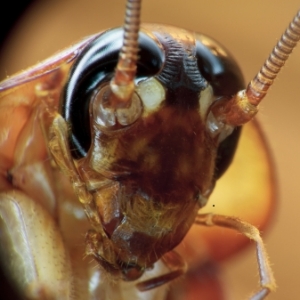
Running cockroaches start to recover from being shoved sideways before their dawdling nervous system kicks in to tell their legs what to do, researchers have found. These new insights on how biological systems stabilise could one day help engineers design steadier robots and improve doctors' understanding of human gait abnormalities.
In experiments, the roaches were able to maintain their footing mechanically—using their momentum and the spring-like architecture of their legs, rather than neurologically, relying on impulses sent from their central nervous system to their muscles.
"The response time we observed is more than three times longer than you'd expect," said Shai Revzen, an assistant professor of electrical engineering and computer science, as well as ecology and evolutionary biology, at the University of Michigan. Revzen is the lead author of a paper on the findings published online in Biological Cybernetics. It will appear in a forthcoming print edition.
"What we see is that the animals' nervous system is
working at a substantial delay," he said. "It could potentially act a
lot sooner, within about a thirtieth of a second, but instead, it kicks in
after about a step and a half or two steps—about a tenth of a second. For some
reason, the nervous system is waiting and seeing how it shapes out."
How the study was done
To arrive at their findings, the researchers sent 15 cockroaches (one-by-one, in 41 trials) running across a small bridge onto a placemat-sized cart on wheels. The cart was attached to an elastic cord that was pulled tight like a loaded slingshot and held in place with a strong magnet on the other side. Once a roach was about a body length onto the cart, the researchers released the magnet, sending the cart hurling sideways.
The force was equivalent to a sumo wrestler hitting a jogger with a flying tackle, said Revzen, adding that cockroaches are much more stable than humans.
To gather detailed information about the roaches' gait, the researchers utilized a technique Revzen developed several years ago called kinematic phase analysis. It involves using a high-speed camera to constantly measure the position of each of the insects' six feet as well as the ends of its body. A computer program then merges the continuous data from all these points into an accurate estimate of where the roach is in its gait cycle at all times.
The approach gives scientists a more detailed picture than just measuring the timing of footfalls—a common metric used today to study gait.
In kinematic phase analysis, the signals are converted into a wave graph that illustrates the insect's movement pattern. The pattern only changes when the nervous system kicks in. How do the researchers know this? In a separate but similar experiment, they implanted electrodes into the legs of seven cockroaches to measure nerve signals.
The nervous-system delay the researchers observed is substantially longer than scientists expected, Revzen said. And it runs contrary to assumptions in the robotics community, where computers stand in for brains and the machines' movements are often guided by continuous feedback to that computer from sensors on the robots' feet.
Implications of the findings
Revzen said the new findings might imply that the biological brain, at least in cockroaches, adjusts the gait only at whole-step intervals rather than at any point in a step. Periodic, rather than continuous, feedback systems might lead to more stable (not to mention energy-efficient) walking robots—whether they travel on two feet or six.
Robot makers often look to nature for inspiration. As animals move through the world, they have to respond to unexpected disturbances like rocky, uneven ground or damaged limbs. Revzen and his team believe that patterns in how they move as they adjust could give away how their machinery and neurology work together.
"The fundamental question is, 'What can you do with a mechanical suspension versus one that requires electronic feedback?" Revzen said. "The animals obviously have much better mechanical designs than anything we know how to build. But if we could learn how they do it, we might be able to reproduce it."
More than 70 percent of Earth's land surface isn't navigable by wheeled or tracked vehicles, so legged robots could potentially bridge the gap for ground-based operations like search and rescue and defence.
For human gait analysis, Revzen and colleagues said their noninvasive, high-resolution kinematic phase approach could be valuable in the biomedical community.
"Falls are a primary cause for deterioration in the elderly," Revzen said. "Anything we can do to understand gait pathology and stabilization of gait is very valuable."
These experiments were conducted at the University of California, Berkeley, before Revzen came to U-M. The work was funded by the National Science Foundation.