Publications
 Partners


A 16-year-old US girl who plummeted almost a kilometre to the ground in a skydiving accident survived and is recovering from her many injuries.
Dr Jeffrey Bender, a trauma surgeon, said Makenzie Wethington hurt her liver and broke her pelvis, lumbar spine in her lower back, a shoulder blade and several ribs in Saturday's fall. She also has a broken tooth.
Skydivers can be killed by faulty parachutes, but more often it is the result of human error, says Dr Anton Westman from the Umea University Hospital in Sweden, who has written a thesis on the topic.
His research has unearthed that the "risk of death per skydive in Sweden compares roughly to the risk of a mother dying during childbirth – a chance of 1 in 100 000." About 30 people a year die from skydiving accidents in the US. It is estimated that about 350 000 people make approximately 3 million jumps a year in that country.
But he also mentions that skydivers typically can make up to 10 jumps a day, which increases the odds of an accident. He stresses the importance of checking all equipment thoroughly.
Skydiving injuries often involve dislocations of limbs, and bone fractures during high impact landings, on both land and water. Parachute or lifejacket malfunctions can also hugely increase injury risk. Spinal cord injuries, paralysis and traumatic brain injuries have also been recorded.
This accident in Johannesburg has brought the safety of skydiving, bungee jumping and BASE jumping.
Bungee jumping and cable jumping
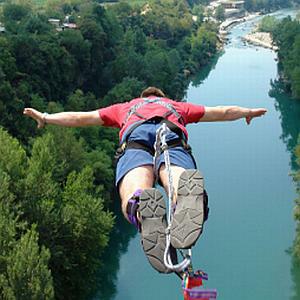
The difference between bungee jumping and cable jumping is minimal. Both involve jumping from a tall structure, such as a building, a bridge or a crane, to which you’re attached by elastic cord. The elastic material stretches and absorbs the energy of your descent, giving you a short free-fall. Cable jumping tends to involve swinging across the drop, and slowly being lowered to safety after the initial jump.
How dangerous is this?
Statistically speaking, the chances of dying on a bungee jump are about one in 500,000 – about the same as travelling 161 kilometres by car. Most companies offering bungee jumping will have a safety record on view. This is usually shown as the percentage of incident-free jumps.
Accidents mostly occur when the cord is not attached securely to the platform or to the jumper, or if the jumper somehow gets entangled in the cord while jumping. The size of the jumper, the height of the drop, whether it is a tandem jump, are all things to be considered when making calculations on the platform before the jump. Head injuries are the most common cause of death.
There are many other ways in which jumpers can be injured:
• dislocations
• whiplash
• rope burns
• back injuries
• eye trauma
• pinched fingers
Adrenaline, a hormone released by the body during times of shock or stress, gives a natural boost of energy. As it travels through the bloodstream, it increases heart rate, blood sugar, and metabolic rate. It is adrenaline that is responsible for the extreme sense of well-being after doing something like a bungee jump.
"There are definitely dangers,” says Dr Bets Breedt, Health24's CyberDoc. "People who have heart problems, high blood pressure, a danger of aneurysms, joint problems, back problems, and arthritis should think twice before doing this. In short, any person who has cardiovascular problems or who would not take part in contact sport, should probably not be doing this."
Safesport.co.uk , a website dedicated to safety in extreme sports, advises people to have their medical condition checked before jumping.
It also advises the following:
• Check the safety record of the company
• Ask about their safety procedures
• Ask about the checking and re-checking of equipment (calculations have to be made individually for each jumper)
• Don't jump during bad weather
• Wear casual clothing that does not interfere with proper harnessing
• Don't jump if there are any medical risks to you
• Ask about medical attention/first aid/rescue operations
The origins
The origin of this gravity-defying practice is thought to be a traditional test of courage performed by the young men of Pentecost Island in Vanuatu, who would jump from mind-boggling heights with nothing more than vines tied to their ankles to keep them from meeting their maker.
The first modern bungee jump was done in 1979 by five Oxford students off the Clifton Suspension Bridge. They were arrested.
Among the victims is, famously, professional bungee jumper Laura Patterson, who died of severe head injuries after colliding with the concrete playing field at the Louisiana Superdome in 1997.
But all things considered, bungee jumping is not at the top of the danger list. While stats are difficult to verify, it appears that BASE jumping (parachuting off a fixed structure), free diving, cave diving and speed skiing – in that order - are the most dangerous extreme sports. Bungee jumping does not feature in the top 10 on this list.
(References: Associated Press, Health24, howstuffworks.com, skydivingmagazine.com, safesport.co.uk, medstudents.com)
(Susan Erasmus, Health24. updated February 2013)
Dr Jeffrey Bender, a trauma surgeon, said Makenzie Wethington hurt her liver and broke her pelvis, lumbar spine in her lower back, a shoulder blade and several ribs in Saturday's fall. She also has a broken tooth.
Skydivers can be killed by faulty parachutes, but more often it is the result of human error, says Dr Anton Westman from the Umea University Hospital in Sweden, who has written a thesis on the topic.
His research has unearthed that the "risk of death per skydive in Sweden compares roughly to the risk of a mother dying during childbirth – a chance of 1 in 100 000." About 30 people a year die from skydiving accidents in the US. It is estimated that about 350 000 people make approximately 3 million jumps a year in that country.
But he also mentions that skydivers typically can make up to 10 jumps a day, which increases the odds of an accident. He stresses the importance of checking all equipment thoroughly.
Skydiving injuries often involve dislocations of limbs, and bone fractures during high impact landings, on both land and water. Parachute or lifejacket malfunctions can also hugely increase injury risk. Spinal cord injuries, paralysis and traumatic brain injuries have also been recorded.
This accident in Johannesburg has brought the safety of skydiving, bungee jumping and BASE jumping.
Bungee jumping and cable jumping
The difference between bungee jumping and cable jumping is minimal. Both involve jumping from a tall structure, such as a building, a bridge or a crane, to which you’re attached by elastic cord. The elastic material stretches and absorbs the energy of your descent, giving you a short free-fall. Cable jumping tends to involve swinging across the drop, and slowly being lowered to safety after the initial jump.
How dangerous is this?
Statistically speaking, the chances of dying on a bungee jump are about one in 500,000 – about the same as travelling 161 kilometres by car. Most companies offering bungee jumping will have a safety record on view. This is usually shown as the percentage of incident-free jumps.
Accidents mostly occur when the cord is not attached securely to the platform or to the jumper, or if the jumper somehow gets entangled in the cord while jumping. The size of the jumper, the height of the drop, whether it is a tandem jump, are all things to be considered when making calculations on the platform before the jump. Head injuries are the most common cause of death.
There are many other ways in which jumpers can be injured:
• dislocations
• whiplash
• rope burns
• back injuries
• eye trauma
• pinched fingers
Adrenaline, a hormone released by the body during times of shock or stress, gives a natural boost of energy. As it travels through the bloodstream, it increases heart rate, blood sugar, and metabolic rate. It is adrenaline that is responsible for the extreme sense of well-being after doing something like a bungee jump.
"There are definitely dangers,” says Dr Bets Breedt, Health24's CyberDoc. "People who have heart problems, high blood pressure, a danger of aneurysms, joint problems, back problems, and arthritis should think twice before doing this. In short, any person who has cardiovascular problems or who would not take part in contact sport, should probably not be doing this."
Safesport.co.uk , a website dedicated to safety in extreme sports, advises people to have their medical condition checked before jumping.
It also advises the following:
• Check the safety record of the company
• Ask about their safety procedures
• Ask about the checking and re-checking of equipment (calculations have to be made individually for each jumper)
• Don't jump during bad weather
• Wear casual clothing that does not interfere with proper harnessing
• Don't jump if there are any medical risks to you
• Ask about medical attention/first aid/rescue operations
The origins
The origin of this gravity-defying practice is thought to be a traditional test of courage performed by the young men of Pentecost Island in Vanuatu, who would jump from mind-boggling heights with nothing more than vines tied to their ankles to keep them from meeting their maker.
The first modern bungee jump was done in 1979 by five Oxford students off the Clifton Suspension Bridge. They were arrested.
Among the victims is, famously, professional bungee jumper Laura Patterson, who died of severe head injuries after colliding with the concrete playing field at the Louisiana Superdome in 1997.
But all things considered, bungee jumping is not at the top of the danger list. While stats are difficult to verify, it appears that BASE jumping (parachuting off a fixed structure), free diving, cave diving and speed skiing – in that order - are the most dangerous extreme sports. Bungee jumping does not feature in the top 10 on this list.
(References: Associated Press, Health24, howstuffworks.com, skydivingmagazine.com, safesport.co.uk, medstudents.com)
(Susan Erasmus, Health24. updated February 2013)